
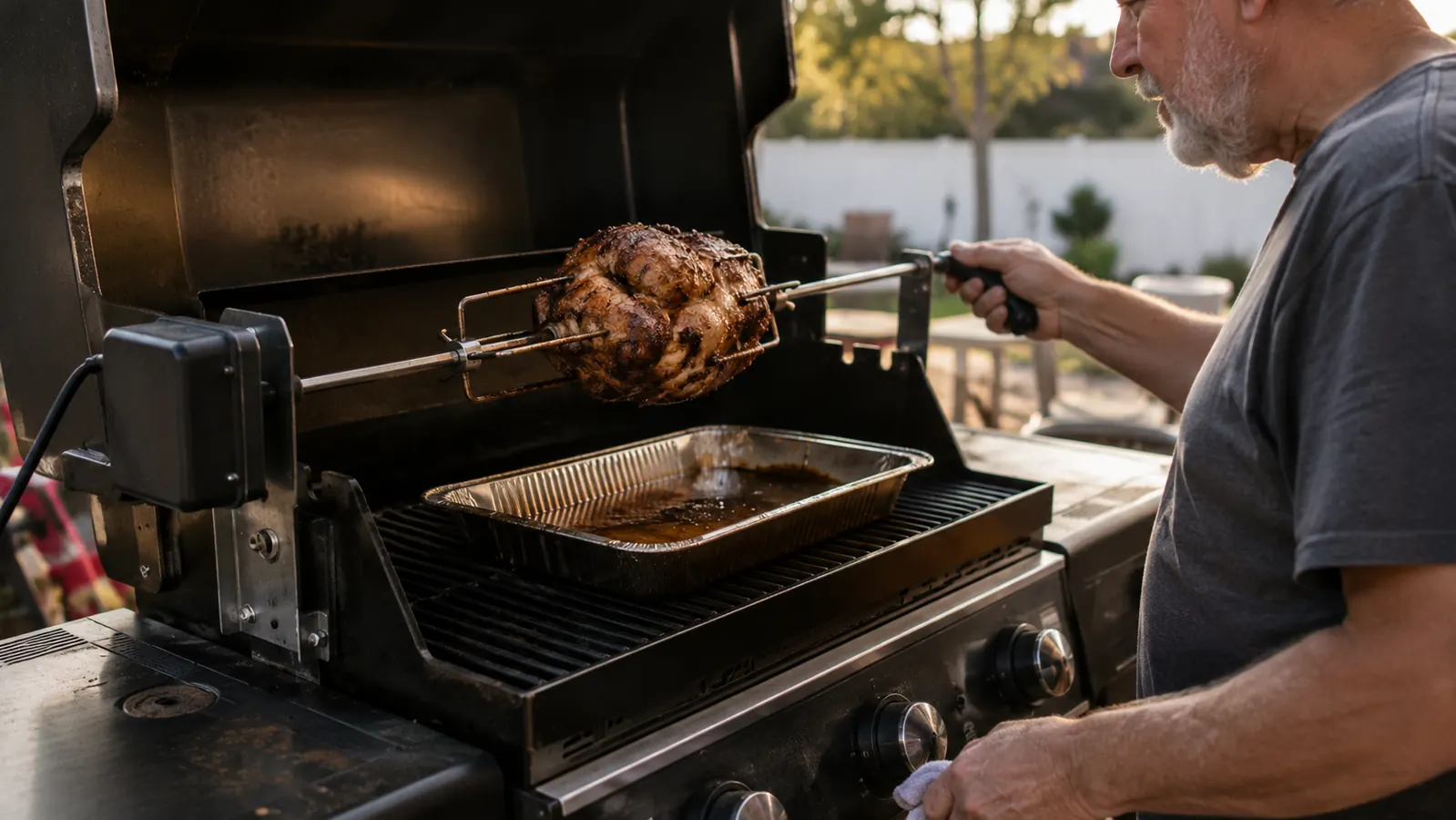
I already wrote one review of this kit after six months of Sunday chickens, and it was mostly a love letter. This one isn't. I'm Carl Dwyer, 65, semi-retired, and I've had the Dyna-Glo Universal Rotisserie Kit bolted to my 3-burner gas grill long enough now to hit the parts nobody puts in their first review, the parts that show up once the honeymoon wears off. If you've read five other reviews of this thing and they all sound suspiciously identical, this is the one written by a guy who's also scrubbed grease out of his garage sink three times this month.
None of what follows changes my overall opinion that this is a solid piece of gear for the money. But there's a gap between 'this works' and 'this is exactly as easy as the box makes it look,' and I want to close that gap for anyone about to click buy expecting a plug-and-play experience. Bonnie's the one who pushed me to write this second review, actually, after she watched me mutter my way through a lamb cook one Saturday and said, out loud, 'somebody should warn people about this part.'
The Quick Verdict
A capable rotisserie motor with real muscle behind it, but the fitment isn't as universal as advertised and the cleanup routine is more involved than any listing photo lets on.
Amazon Check Today's Price →Read three glowing reviews and you'd think this thing installs itself.
It doesn't, and I'll walk you through exactly where it gets fussy. But once it's dialed in, it does earn its spot on the grill. Check the current listing for today's price and availability.
Amazon Check Today's Price on Amazon →How We Tested It This Time Around
For this review I deliberately pushed the kit past chicken. My neighbor Hank has a bigger gas grill than mine, a different brand entirely, and he asked if he could borrow the Dyna-Glo kit for a leg of lamb he was planning for a family get-together. I said yes on one condition, that I got to document every step of him fighting with it on unfamiliar hardware. That turned into the most useful data I've gathered on this kit, because it exposed problems my own grill had quietly been hiding from me.
I also ran a pork shoulder through it on my own grill, something bulkier and more irregularly shaped than anything I'd tried before, specifically to see how the counterweight system handled a cut of meat that isn't naturally cylindrical the way a chicken or a rolled roast is. Between Hank's lamb and my pork shoulder, I got a much clearer picture of where this kit is genuinely easy and where it demands patience nobody warns you about.
The Fitment Isn't As Universal As the Name Implies
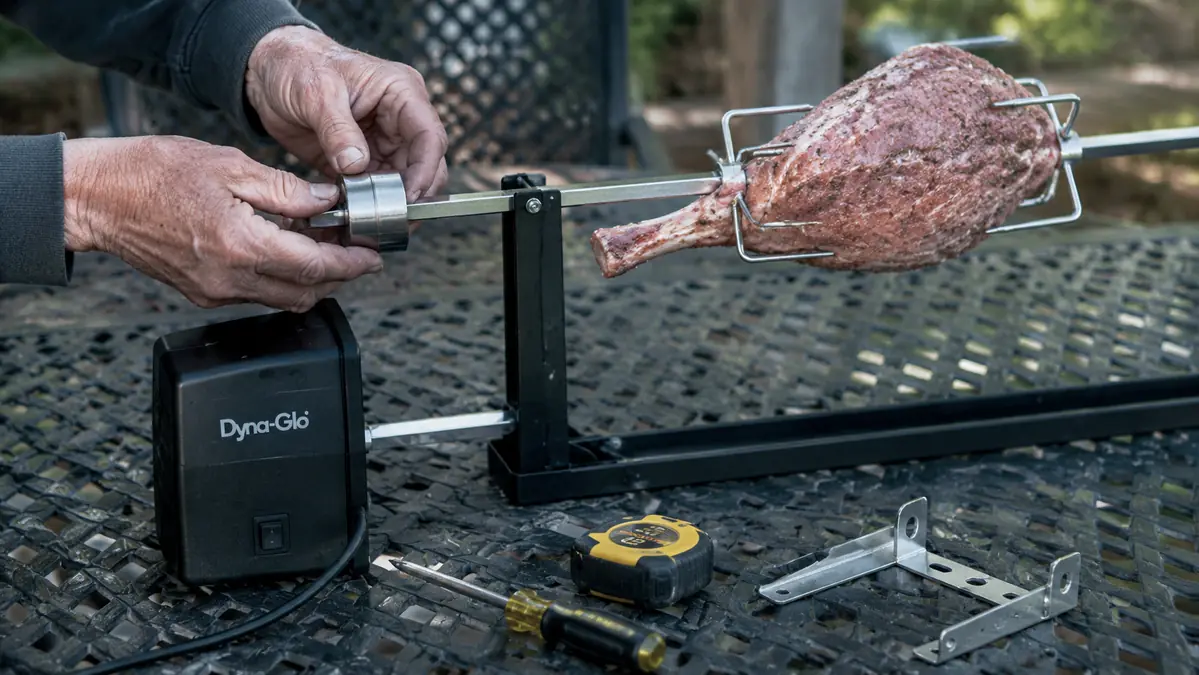
'Universal' is doing a lot of work on that packaging. My grill has a factory-drilled mounting point on the right burner box that the bracket lined up with reasonably well, needing just two new holes. Hank's grill has no factory mounting point at all, and the Dyna-Glo bracket's slotted holes didn't sit flush against his burner box's contour, which is slightly curved where mine is flat. He ended up shimming the bracket out with a stack of stainless washers just to get it level, something you won't find mentioned anywhere in the included instructions.
The spit rod itself is a solid square bar, which I like structurally, but that square profile means it only clears certain grill lids with the warming rack removed, and on a couple of grill models I looked up afterward out of curiosity, the rod is genuinely too long for the firebox width without cutting into the lid gasket area. Nobody advertises grill dimensions clearly enough for you to check this before buying, so you're stuck measuring your own setup and hoping.
The motor bracket also assumes your burner box has a flat vertical surface to clamp onto. If your grill has a rounded or ribbed side panel, textured for heat dissipation the way some newer models are, you're going to be drilling into sheet metal that doesn't want to hold a screw thread cleanly. I didn't hit this problem myself, but I heard about it from two other owners in a grilling forum thread I stumbled across while researching this piece, and it lines up with what I saw happen on Hank's grill.
Even the motor's power cord length turned out to matter more than I expected. On my grill the nearest outdoor outlet is close enough that the stock cord reaches with a few feet to spare. On Hank's patio, the outlet sits on the opposite wall, and he ended up running a heavy-duty outdoor extension cord across the deck every time he wants to use it, which is exactly the kind of tripping hazard nobody thinks to check before ordering.
Balancing an Irregular Cut Is a Different Skill Than Balancing a Chicken
A whole chicken is basically a football with legs. It's naturally close to symmetrical once trussed, and the counterweight system handles it without much drama. A leg of lamb is not symmetrical at all. It's thick at one end, tapers to almost nothing at the other, and has a bone running through it at an angle that fights against clean centering no matter how you truss it.
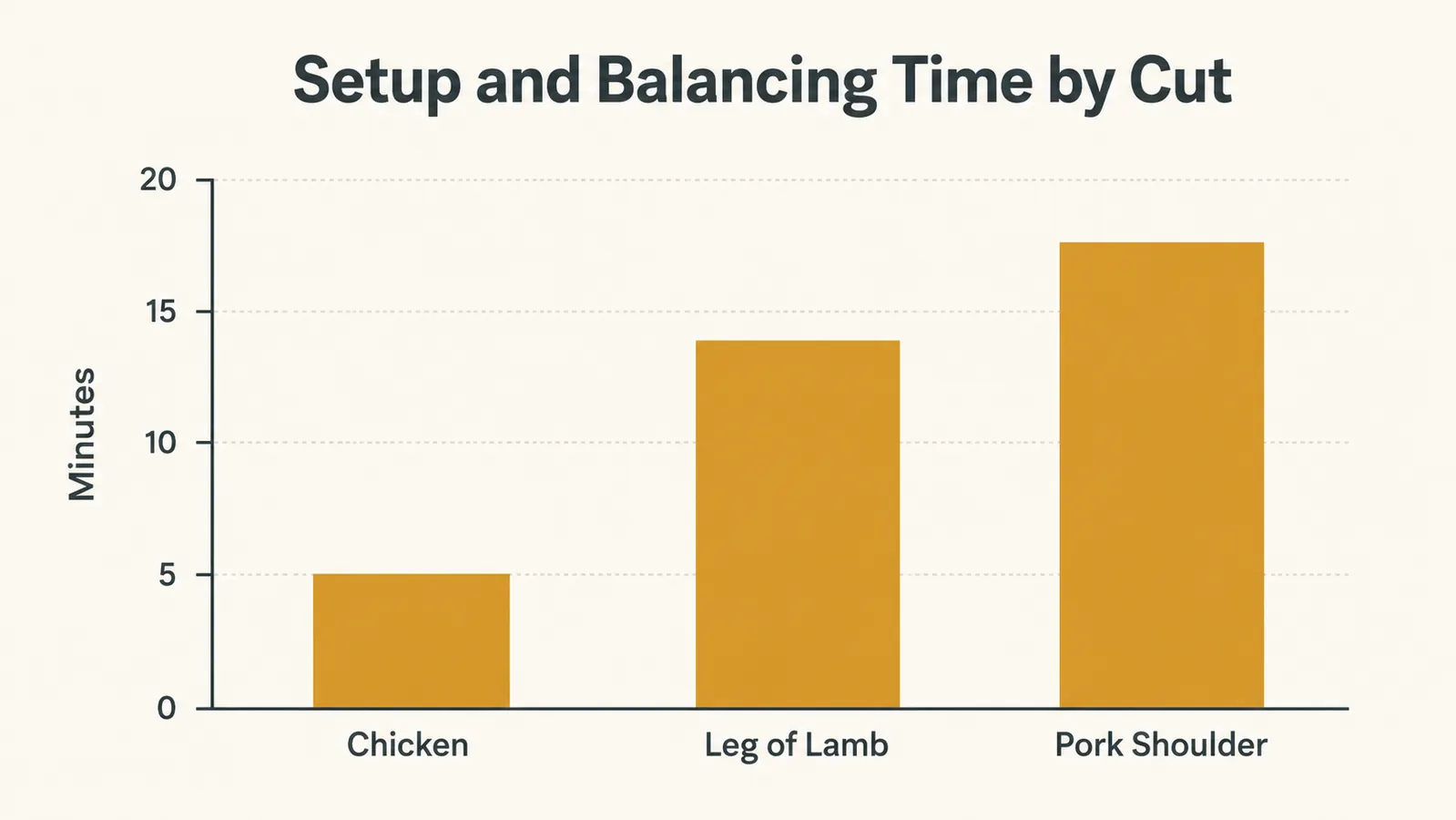
Hank spent almost twenty minutes trying to get his lamb balanced before giving up and calling me over. The motor kept lugging every few rotations, that same strained sound I remember from my own early chicken cooks, except this time repositioning the counterweight barely helped because the meat's mass distribution just wasn't cooperating. What actually fixed it was trimming a chunk of fat off the thick end to even out the weight, something the instructions never suggest and something I only thought to try because I'd read a butcher's blog post about spit-roasting irregular cuts years ago.
My pork shoulder gave me a similar headache. It's a lumpy, asymmetrical piece of meat by nature, and getting it to spin without wobbling took real trial and error, pulling it off the forks twice to reposition before the rotation finally smoothed out. If your mental model of this kit is 'strap meat to rod, walk away,' irregular cuts will disabuse you of that fast. Chicken and cylindrical roasts are the forgiving cases. Everything else takes work the marketing never mentions.
What surprised me most is how much trussing technique matters here compared to grate cooking. On a grate, a sloppy truss just means an uneven-looking bird. On a spit, a sloppy truss means loose limbs flopping outward as they rotate, which throws off the balance mid-cook even after you thought you'd nailed it at the start. I've had to re-truss a chicken leg back down twice during a single cook because it worked itself loose from the twine around the forty-minute mark.
The Motor Noise Nobody Mentions
Every review, including my first one, talks about the motor's strength but almost nobody mentions what it actually sounds like running for ninety straight minutes. On a balanced chicken, it's a low, steady hum, comparable to a box fan on its lowest setting, easy to tune out. Under load with something heavier or slightly imperfect on the balance, though, that hum turns into an audible whine that rises and falls with each rotation, and it carries further across a quiet backyard in the evening than I expected the first time I ran a cook after dark.
It's never been loud enough that Bonnie's asked me to move it, but on my pork shoulder cook, our next-door neighbor's dog barked at it twice from across the fence, which tells you it's audible enough to register as an unfamiliar mechanical sound. If you live somewhere with close neighbors and you're planning evening cooks, it's worth knowing this isn't dead silent the way a still grate cook is.
The Cleanup Nobody Photographs
Every rotisserie photo you'll see online, mine included in my last review, shows a beautifully browned bird spinning in golden light. What you don't see is the fifteen minutes afterward with a scrub brush and a sink full of gray water. The forks have real teeth, which I praised in my last review for grip, but those same teeth trap rendered fat and skin fragments in a way a smooth grate never does. Getting them properly clean means picking at the tines with a toothpick or a wire brush corner, not just a quick rinse.
The spit rod's square profile has the same problem on a smaller scale. Grease runs down the flat sides and pools in the corners where the edges meet, and if you let it sit even a day before washing, it turns tacky and needs actual scrubbing instead of a wipe. I've started keeping a dedicated bucket of hot soapy water going the moment I pull meat off, because letting the hardware cool with grease still on it roughly doubles the cleaning effort.
The Dyna-Glo motor housing itself needs attention too, something I underplayed in my first review. Grease spatter drifts upward off the rotating meat and lands on the housing's underside and vents. I wipe it down after every use now with a degreasing spray and a rag, and when I skipped that step twice in a row back in March, I noticed the motor running slightly warmer than usual, which spooked me enough to open the housing and clean the vents out properly. It wasn't damaged, but it was a reminder that this thing needs upkeep beyond just rinsing the forks.

The Drip Pan Situation Is Its Own Adjustment
Nobody talks about drip pan management because it sounds too mundane for a product review, but it's one of the more annoying parts of ownership. A standard foil drip pan fills up faster under a rotating roast than it does under grate cooking, because all that self-basting fat has nowhere to go but down into one concentrated spot instead of spreading across a grate and partially burning off. On the pork shoulder cook, my pan overflowed at around the ninety-minute mark because I'd used the same size pan I always use for chicken, not accounting for a fattier cut rendering more liquid.
Now I size my pan to the meat and check it at the halfway point on anything over six pounds, something that took me a scorched grease flare-up to learn. It's a small habit to build, but it's exactly the kind of detail that separates someone who's used this kit twice from someone who's used it twenty times, and it's nowhere in the printed instructions.
What We Liked
- Motor has genuine torque, handled a bulky pork shoulder without stalling once balanced
- Square spit rod resists twisting under load better than round alternatives I've read about
- Toothed forks grip irregular cuts like lamb legs without slipping mid-cook
- Withstood a season of use across two different grills without hardware failure
- Rewards the extra effort with genuinely even cooking on cuts a grate handles poorly
Where It Falls Short
- Bracket fitment varies a lot depending on your specific grill's burner box shape
- Irregular cuts like lamb legs require real trial and error to balance, not a quick strap-and-go
- Motor whine becomes noticeably audible under heavier or imperfectly balanced loads
- Cleanup is more involved than any product photo suggests, especially the toothed forks
- Standard drip pans overflow faster than expected on fattier cuts
- No guidance in the instructions for any of these real-world adjustments
The photos sell you a spinning golden bird. Nobody sells you the sink full of gray water twenty minutes later.
Who This Is For
This kit is for someone who's willing to treat the first few cooks as a learning process rather than expecting instant results, and who doesn't mind an extra fifteen minutes of cleanup as the cost of genuinely even cooking. If you already measure your grill dimensions before buying accessories, and you're the type who'll trim a little fat off a lopsided cut to make the physics work, you'll get real value here and probably end up as evangelical about it as I was in my first review. It also helps if your outdoor outlet is within easy cord reach of wherever the motor mounts, so you're not improvising with extension cords across the patio.
Who Should Skip It
If you want something that mounts in five minutes flat with zero fuss, or if you're only ever cooking chicken and have no interest in branching out to irregular cuts like lamb or pork shoulder, you may find the fitment fiddling and the balancing learning curve more annoying than the payoff justifies. And if scrubbing greasy forks after every cook sounds like a dealbreaker rather than a minor chore, or if a steady motor whine during a quiet evening cook would bother you or your neighbors, this isn't the low-maintenance grill accessory the marketing photos make it look like.
Still worth it, once you know what you're actually signing up for.
The fitment quirks and cleanup routine are real, but so is the improvement in how evenly everything cooks. Check the current listing for today's price and availability.
Amazon Check Today's Price on Amazon →