
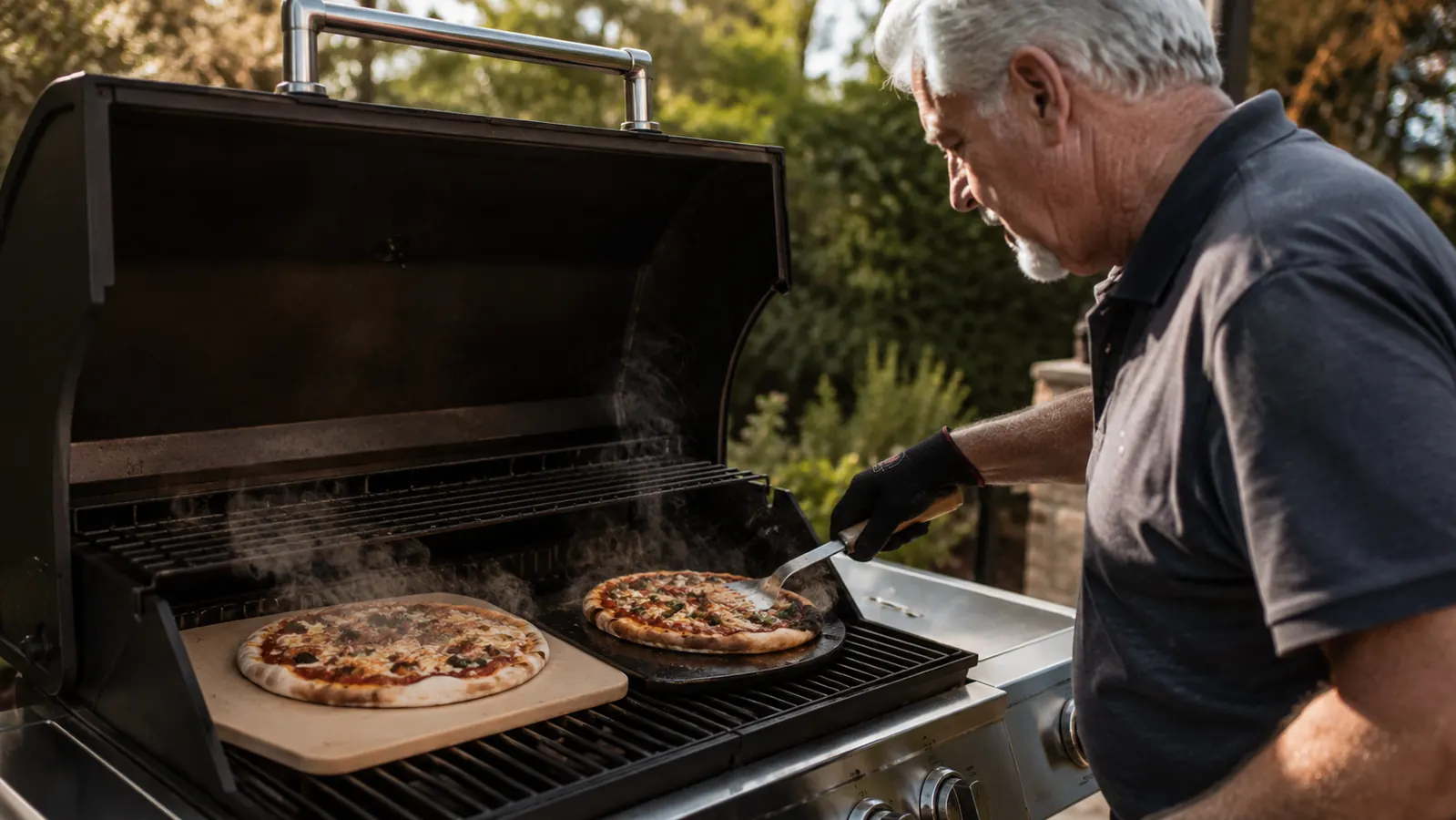
The short answer, if you're standing in your kitchen right now trying to decide before Friday's pizza night: a cordierite stone like the Hans Grill Pizza Stone PRO XL gives you a more forgiving, more even bake and handles the swing from a 500-degree grill to a cold patio table without cracking, while a steel plate heats up faster and puts out a slightly crisper, more pizzeria-style bottom crust if you're willing to baby it a little more.
I've cooked on both, on the same three-burner gas grill, using the same dough recipe, over the course of a full grilling season. My buddy Hank swears by his steel plate and won't hear otherwise. I went the stone route after my first steel purchase turned into a warped, rust-freckled disappointment within two months. Neither of us is entirely right, and neither of us is entirely wrong, which is exactly why this comparison exists instead of a simple 'buy this one' verdict.
This isn't a lab test with a thermometer gun and a spreadsheet, though I did keep notes on a legal pad taped to the side of my grill cart most of the summer. It's what happened, week after week, when real dough met real heat on both surfaces, with real grandkids waiting at the patio table for their slice.
| Pizza Stone | Pizza Steel for Grilling | |
|---|---|---|
| Material | Cordierite ceramic stone (Hans Grill Pizza Stone PRO XL) | Rolled carbon steel plate |
| Preheat time to 500°F | About 25-30 minutes on the grill | About 15-18 minutes on the grill |
| Bottom crust texture | Even, slightly softer crumb with good char spots | Crisper, more shatter-snap bottom crust |
| Weight | Roughly 8 lbs, one-handed to move | Roughly 15-20 lbs, two-handed to move |
| Thermal shock risk | Very low, handles quick temp swings well | Low, but avoid dropping cold water on hot steel |
| Rust or corrosion risk | None, it's ceramic | Needs oiling and drying to avoid rust |
| Cleanup | Scrape and brush, never soap | Scrape, dry immediately, re-oil |
| Best for | Backyard cooks who want one forgiving surface for pizza, bread, and reheating | Cooks chasing a specific crisp Neapolitan-style bottom crust |
| Long-term durability outdoors | Handles being left in a closed grill through humid weather | Needs to come inside or get a thick oil coat between uses |
How I Tested Both
I kept the variables as close as I could manage in a backyard, not a test kitchen. Same three-burner gas grill, same 72-hour cold-fermented dough recipe Bonnie and I have used for years, same 500-degree target on the lid thermometer, and the same rotation of toppings so I wasn't comparing a plain margherita to a loaded meat lover's and calling it fair. I ran the stone one Friday, the steel the next, back and forth for most of a summer, and had Hank over often enough that his palate served as a second opinion instead of just my own.
What I was watching for was simple: how long it took each surface to actually reach temperature, how the bottom crust looked and sounded when I tapped it with the peel, and how much fuss the surface itself demanded once dinner was done and the grill was cooling. I wasn't trying to crown a winner going in. I genuinely expected the steel to run away with it, since everything I'd read online said steel was the serious cook's choice and stone was the beginner's compromise.
That's not quite how it played out. The steel did win on raw crust snap most weeks, no argument there. But it also demanded a level of attention, drying it fast, oiling it before it went back in the cabinet, that I kept forgetting to give it after a long day, especially the weeks Travis brought the kids over and dinner turned into a scramble. The stone never once punished me for being a little sloppy with the cleanup, and by August that mattered more to me than an extra ten percent of crust crispness.
By the end of the season the legal pad had more notes about the steel's maintenance than about its crust, which told me something on its own. A tool that keeps showing up in your notes for the wrong reasons is a tool that's asking more of you than a backyard cook on a Friday night really wants to give.
Where the Hans Grill Stone Wins
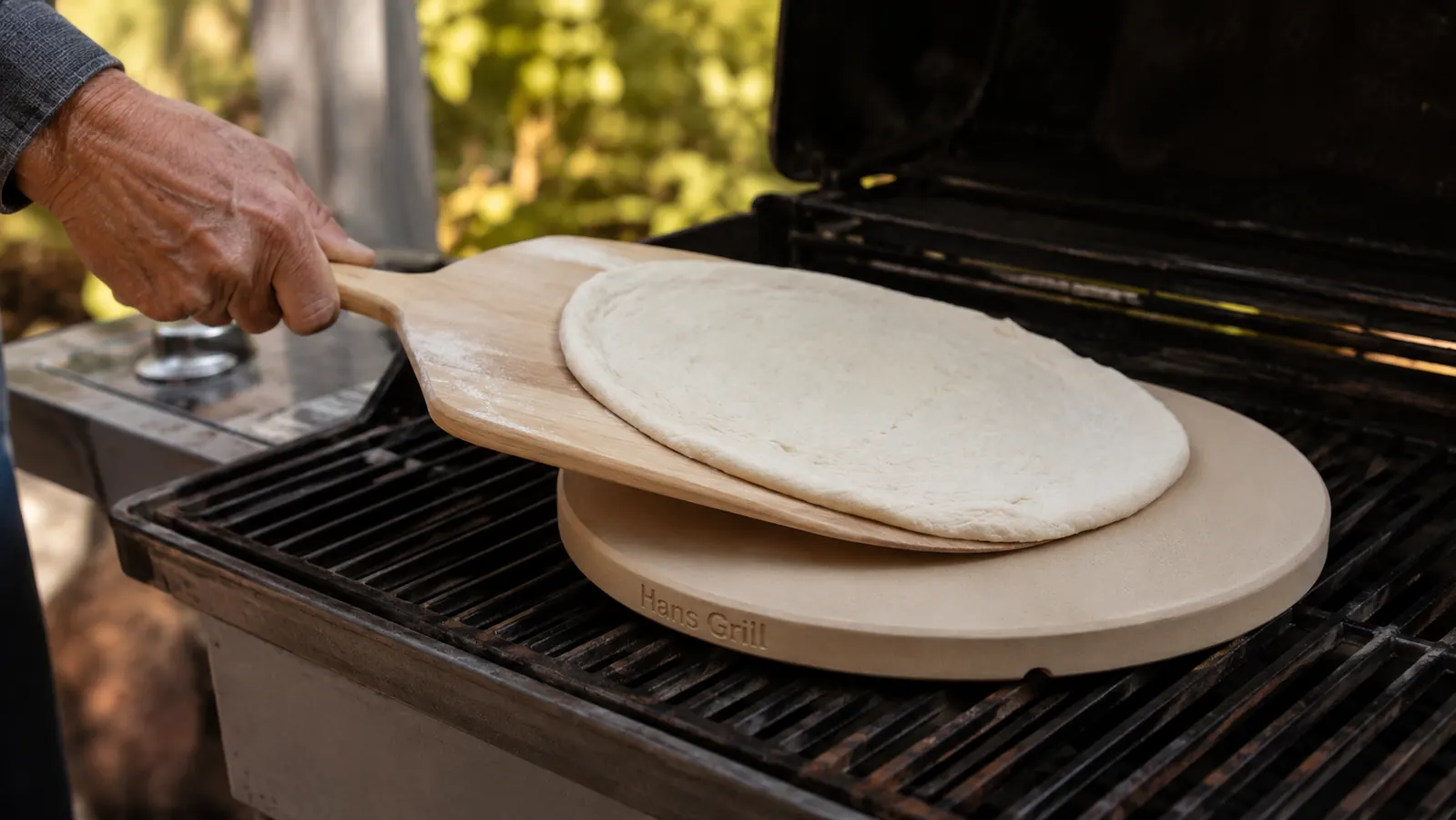
The biggest thing the Hans Grill stone has going for it is that it forgives you. I've slid a dough round on slightly off-center, dropped a corner of cheese right onto the surface, and closed the lid on a grill running hotter than I meant it to, and the stone just took it. Cordierite is built to handle thermal swings, the same material shows up in kiln shelves and some catalytic converters because it doesn't crack under heat stress the way regular ceramic or a cheap steel blank might. After a full season of near-weekly use on my gas grill, mine still looks and cooks the same as the day it arrived, no hairline cracks, no warping.
It's also just easier to live with day to day. At around 8 pounds, I can lift it off the grates one-handed to check the underside or reposition it, where the steel plate Hank uses takes both hands and a little grunt. I store the Hans Grill stone in the cabinet next to my baking sheets between cookouts, no oiling routine, no drying it off before it goes away, no rust spots to scrub in the spring. When Bonnie asks me to make bread on the grill for Sunday dinner, the same stone handles that too, something the steel plate does but not quite as gracefully since it holds onto heat a little too aggressively for delicate crusts.
There's a quieter benefit too, one I didn't expect going in. The stone's size, a full 15 inches across on the PRO XL, meant I could fit a genuinely large pizza on it without the edges hanging off into the flame, which happened twice on Hank's smaller steel plate before he learned to size his dough down to fit. More surface area meant fewer trips back and forth to the kitchen refilling the peel, which on a night with four hungry grandkids circling the table is worth more than it sounds.
Where the Steel Plate Wins
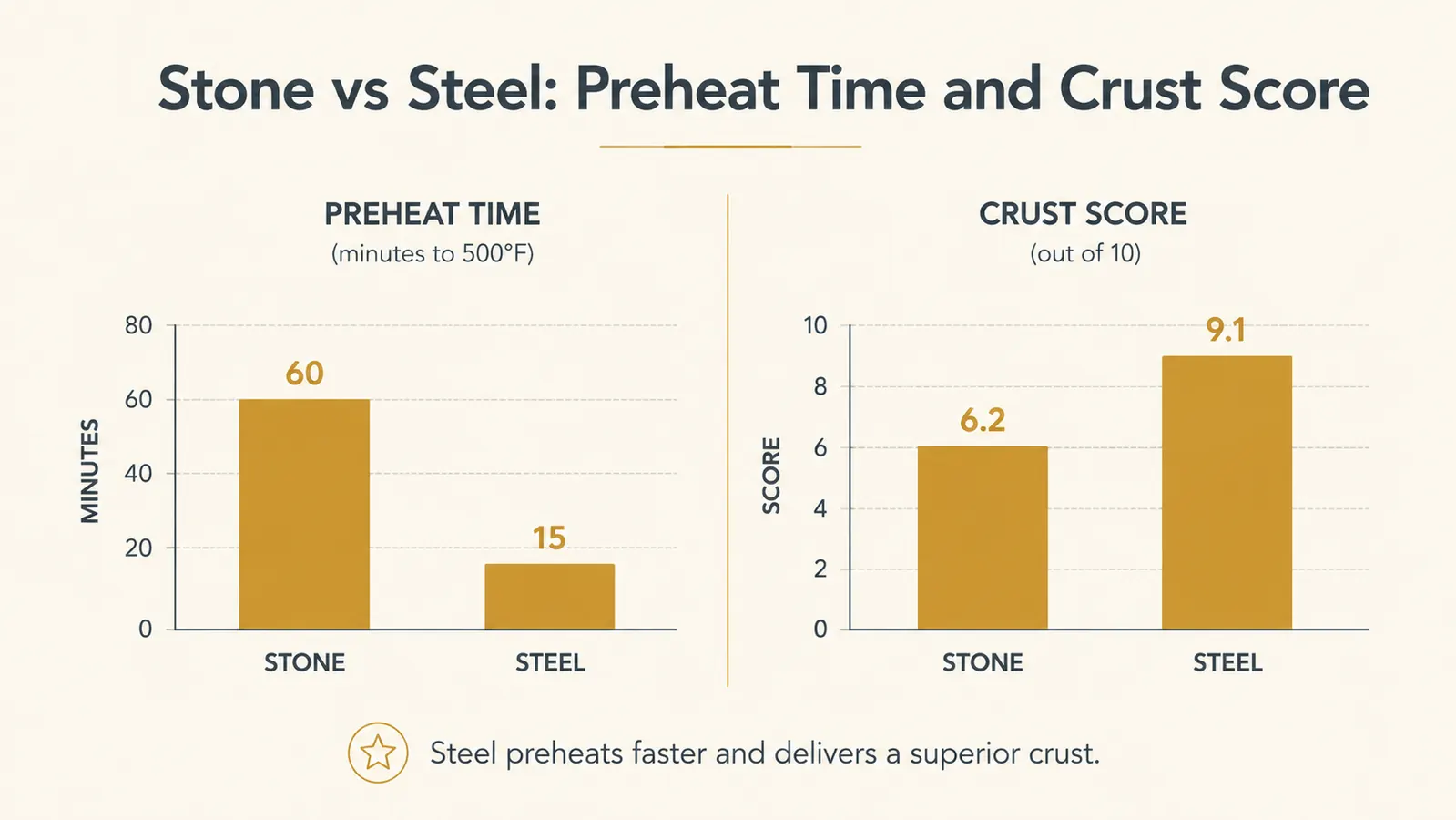
I won't pretend the steel doesn't do one thing better: raw heat transfer. Steel conducts heat faster and holds a higher surface temperature than ceramic, so Hank's pizzas come off the grill with that slightly blistered, shatter-crisp bottom you get at a real pizzeria with a deck oven. His preheat time is also noticeably shorter, close to fifteen minutes versus my twenty-five to thirty, which matters if you've got hungry grandkids circling the patio table and dinner is running late.
The steel also just takes up less real estate in some setups. A thinner plate slides into a tighter gap between grates and lid than a thick stone will, which is worth knowing if you're working with a smaller grill than my three-burner setup. If you're chasing one very specific style of pizza crust and you're willing to do the extra maintenance, oiling it after every use, drying it fast so it doesn't rust, storing it somewhere dry, the steel rewards that effort with a crust that's genuinely hard to match on ceramic.
Steel also recovers heat faster between pies. On a night when I'm making four or five personal-sized pizzas back to back for the grandkids, Hank's steel plate barely dips in temperature from one pizza to the next, where my stone needs a couple extra minutes to climb back to full heat after each round trip to the kitchen. If you're feeding a crowd in rapid succession, that recovery speed is a real, measurable edge.
Get the forgiving one first, upgrade later if you want the extra crisp
The Hans Grill Pizza Stone PRO XL handles grill heat swings, doubles for bread, and doesn't ask for babying between cookouts. See today's price and current availability on Amazon.
Amazon Check Today's Price on Amazon →There's also the question of what happens when you get it wrong. I've watched Hank leave his steel plate out under a grill cover during a rainy week and pull it back out with faint rust freckles across one corner. A little steel wool and fresh oil fixed it, but it was a Saturday morning spent scrubbing instead of making dough. My stone has sat through the same humid stretches without a second thought, because there's nothing on cordierite for moisture to grab onto in the first place.
Price is worth a mention here too, though I'll only speak to it in terms of what you get, not what either of us paid. A quality cordierite stone like the Hans Grill PRO XL and a quality carbon steel plate of similar size tend to land in the same rough neighborhood at today's Amazon pricing. Neither one is the budget pick and neither one is the splurge, so the decision really does come down to maintenance tolerance and crust preference rather than what fits the wallet better.
The steel makes a better crust if you baby it. The stone makes a good crust even when you forget to.
Who Should Buy Which
If you're the kind of griller who wants one surface that handles pizza on Friday, a loaf of bread on Sunday, and reheated leftovers on a random Tuesday without a maintenance routine attached, get the Hans Grill stone. That's most of us, honestly, myself included, and it's the reason I still reach for mine every single week instead of the steel plate I tried and eventually gave to Travis. If you've already got your dough recipe dialed in, you know exactly the crust texture you're chasing, and you don't mind drying and oiling a plate after every cook, the steel earns its keep. Hank's not wrong that his crust has a slightly better snap. He's just doing more work for it than I'm willing to do most weeks, and for a lot of backyard cooks, that tradeoff isn't worth it.
If you're brand new to grilled pizza altogether, I'd steer you toward the stone every time. It's the more forgiving surface while you're still figuring out dough hydration, grill temperature swings, and the timing of getting a pie from peel to grate without it sticking. You can always add a steel plate to the rotation later once you know your own habits well enough to keep up with its upkeep.
I've thought about keeping both in rotation permanently, and honestly, plenty of serious backyard cooks do exactly that, reaching for whichever one matches the night. But if you only want to own one, the stone is the one that still gets used every week a year later, and that kind of staying power says more than any single crust comparison ever could.
See why this stone earned the permanent spot on my grill
No rust, no warping, no babysitting between cookouts. Check today's price on the Hans Grill Pizza Stone PRO XL and see current reviews on Amazon.
Amazon Check Today's Price on Amazon →